the economic ideas, for non-economists
a personal view: not endorsed by any organisation
“He who receives an idea from me, receives instruction himself without lessening mine; as he who lights his taper at mine, receives light without darkening me. That ideas should freely spread from one to another over the globe, for the moral and mutual instruction of man, and improvement of his condition, seems to have been peculiarly and benevolently designed by nature, when she made them, like fire, expansible over all space, without lessening their density in any point, and like the air in which we breathe, move, and have our physical being, incapable of confinement or exclusive appropriation. Inventions then cannot, in nature, be a subject of property. Society may give an exclusive right to the profits arising from them, as an encouragement to men to pursue ideas which may produce utility, but this may or may not be done, according to the will and convenience of the society, without claim or complaint from any body. Accordingly, it is a fact, as far as I am informed, that England was, until we copied her, the only country on earth which ever, by a general law, gave a legal right to the exclusive use of an idea. In some other countries it is sometimes done, in a great case, and by a special and personal act, but, generally speaking, other nations have thought that these monopolies produce more embarrassment than advantage to society; and it may be observed that the nations which refuse monopolies of invention, are as fruitful as England in new and useful devices.”
Thomas Jefferson, Letter to Isaac McPherson, August 13, 1813
Summary
Knowledge is a public good because when I use knowledge, I don’t reduce your ability to use the same knowledge. In this way, it is like the beam of a lighthouse. (An example of a rival good is a hamburger: if I eat one, then you can’t eat it too.)
But if anyone can freely use knowledge that I create, then I may not have sufficient incentive to invest enough in research and development. Like all public goods, a free market would result in a market failure (under-production), which Governments should consider correcting.
Intellectual property rights – which give me the right to make a profit on knowledge that I generate – are one way to do this. But they do so at an economic cost. They prevent other people using the knowledge that is created, even though the cost to society of them doing so is zero. Knowledge will be under-consumed as a result of the distorted price, and this reduces society’s welfare compared to undistorted prices.
The economic impact of this distortion is becoming more pronounced as the value of knowledge increases as a share of economic activity, as inequality increases, and as knowledge sharing transactions costs fall. Alternative ways of intervening in the market to promote innovation should be considered, and we should aim for a more diverse set of economic instruments to reward invention and research.
Knowledge is a public good …
Knowledge is a public good (in the economic sense – defined here). Note that a public good is not the same thing as something which is good for the public. There are many things which we regard as good, such as water, which are not public goods. What makes knowledge a public good is that consumption is “non-rival” – that is, the use of knowledge by one person does not reduce the amount available to be used by somebody else.
Other examples of non-rival goods are radio broadcasts, lighthouses and clean air. If I get benefit from these, you don’t benefit any less. There is no cost to society if I choose to use these goods or not. The social marginal cost of consumption (ie the cost to society of an extra person consuming a good) is zero.
In a well functioning market, the price of each good should be equal to the cost of society of it being consumed. If the price is set to less than this, it may be bought and consumed by people who value it less than the cost to society of producing it, so society as a whole will be worse off. If the price is set at a level more than the cost to society, some people will be put off consuming it, even though the value to them would be greater than the cost to society.
Because the social marginal cost of using knowledge is zero, in static equilibrium the optimal price for society to charge to use it is zero. And if the price of using knowledge is above zero, society will under-consume knowledge: that is, we will use less than is socially optimal for us to use.
Free knowledge would be underproduced …
You would be pretty silly to try to make your fortune by running a lighthouse. Although the service you provide would be socially useful, there is no way to collect money from the people who use your service. You cannot exclude ship-owners who chose not to pay from using your beam.
If knowledge were freely available to everyone, then you wouldn’t spend any of your own money investing in research and development to create new knowledge, because there would be no way to charge people for using the knowledge, and so you would not be able to recover your costs. This in turn means that there sould be too little innovation and research. In the long run, society is likely to be worse off, because people will under-invest in the creation of new knowledge. New knowledge is an important driver of improved standard of living and of wealth.
The problem of knowledge is an example of a familiar problem of the supply of public goods. If they are sold at a price above marginal cost, they will be under-consumed. If they are provided at marginal cost (usually, free), they will tend to be under-produced, unless there is some Government subsidy to create an incentive.
Intellectual property rights create an incentive to innovate
Intellectual property rights aim to establish a second-best solution to the problem of the under-supply of knowledge, by creating an incentive to develop knowledge.
Intellectual property rights reward the creators of knowledge by enabling them to charge above the competitive market price (ie zero) for the use of that knowledge, for finite period. In economist-speak, the reward for invention is the right to extract economic rent from consumers.
But intellectual property rights are not like other property rights
Most property rights are created and enforced because their existence improves the allocation of resources. If one person uses land for one purpose, it is not available to someone else for a different purpose (ie, consumption is rival), so society as a whole is better off if the land is used to produce whatever is of maximum overall value. If somebody has property rights on some land, or a machine, they have an incentive to maintain that property and use it to produce goods and services of economic, or sell it to someone who is willing and able to do so. So the allocation of property rights helps to improve the use of scarce resources.
Because knowledge is non-rival, however, the restriction of its use does not improve overall economic welfare in the same way. Allocating property rights over knowledge moves society away from, not towards, an optimum allocation of resources in the short run. This means that intellectual property rights have the opposite effect from other property rights. It is important to avoid allowing the similarity of language to confuse us.
Intellectual property rights are, in effect, a form of state subsidy to those engaged in the creation of knowledge. But instead of society as a whole paying for this subsidy, the state allows the creators of knowledge to charge a tax on the users of that knowledge, at least for a short period of time. Like all taxes, this not only transfers resources from one person to another, but creates a welfare cost to society by distorting the price of the good that has been taxed.
This government intervention to subsidise inventors will be an improvement if the social welfare cost if the distortion that is created is less than the social welfare gain of the additional innovation that this stimulates.
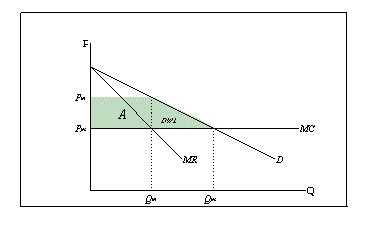
| In the diagram (right), the price that is charged by the monopoly patent holder (PM) is above the marginal cost (MC).
The inventor earns a profit, defined by the area A, which would need to be enough to compensate for the cost and risk of investment. The dead-weight loss to society of this arrangement is shown by the triangle labelled DWL. (Note that there is no mark-up at which the dead-weight loss is zero.) So intellectual property rights create an incentive to invest in knowledge, but at the expense of distorting price signals, creating a misallocation of resources with a social welfare cost, and resulting in an under-consumption of knowledge. |
 |
Creating intellectual property rights is not the only way to correct the market failure
Given that it is economically desirable to tackle the undersupply of knowledge in a free market, society could choose a number of other ways of rewarding the creators of knowledge. These include:
- Voluntary buy-out of patents.
The Government could offer to buy out a patent from an inventor, on a willing buyer-willing seller basis, and then permit free use of the intellectual property. - Compulsory purchase of patents.
There are good precedents for compulsory purchase of property in the public interest (eg to build railway lines). Excessive use of the instrument reduces the incentive over time to invest. - State prizes for inventions.
This instrument has a long pedigree (eg the Longitude Act of 1714, the Kremer prize for human powered flight). On this model, society rewards inventors with a one-off payment for producing a socially useful invention, specified in advance. - Government funding of research and development.
To the extent that Government meets the cost of R&D, there should be no need for the inventor to be rewarded with patents. Examples include the human genome project. The main disadvantage of this approach is that it requires Governments to pick winners. - Value-added services.
In these models, the inventors of products allow the knowledge to be used publicly, but derive economic value from them by packaging new products and providing services to users. The best example of this today is the Open Source software movement.
A mixture of these models could, in practice, be used to create incentives to prevent the under-production of knowledge in circumstances where patent protection and intellectual property rights are not appropriate.
Different systems of rewarding innovation have different economic effects …
First, the approaches above have profoundly different distributional implications. With patents, consumers pay higher prices (ie above the social marginal cost of production) to reward the inventor. In most of the alternatives set out above, society rewards inventors through payments by Government (and hence, ultimately, through the tax system). The incidence of these costs will be different. It may make sense for users of cyclone vacuum cleaners to meet the R&D costs by paying little bit extra for the product. But it is far less clear that this is desirable or acceptable in the case of pharmaceuticals for sick people, or the use of software by the nation’s businesses.
Second, the different models have different welfare impacts. The patent model drives the price of patented goods above the social marginal cost and hence leads to under-consumption. This imposes a welfare cost on people who would have consumed those goods at the optimal level, but cannot do so at the higher price. Tax financed expenditures also have adverse welfare consequences, with a different distribution.
Third, the different models of reward have a significant influence on the nature of research and development that is undertaken. Because reward for R&D is through an entitlement to extract economic rent from consumers, the highest returns are to creation of knowledge which benefits well-off consumers. For example, drugs companies are said to spend ten times more researching cures for baldness or obesity than they do on cures for malaria. Models of rewarding research and development which depend on government payments according to social value would tend to promote knowledge of creation in areas with the highest social return rather than the highest opportunity for rent extraction.
The benefits of patents
Using prices to reward inventors helps to ensure that knowledge is created which is genuinely valuable to people. Using Government purchasing is likely to be less responsive to people’s needs. The arguments against a command economy apply as much to research and development as to any other allocation of resources.
This impact of these economic differences is becoming increasingly pronounced.
There are three fundamental shifts going on which make this issue increasingly important.
First, knowledge is an increasingly important component of economic activity. When patents were first developed, knowledge represented a small component of most economic transactions. The emergence of the knowledge of economy means that it is an increasingly important share of economic activity.
The richest men in the world today, Bill Gates and Larry Ellison, have amassed their wealth through intellectual property. A huge part of what is valuable – software, entertainment, healthcare, financial services, etc – is dependent on knowledge, much of which is protected by IPRs.
Second, global inequality is higher than at any time in history. This means that the distributional impact of intellectual property rights, the social welfare costs, and the distortions to R&D effort, are all greater now than ever before. Research into problems affecting poor people is increasingly marginalised in favour of development of intellectual property for which rich consumers are willing to pay.
Third, the transactions costs of sharing knowledge, locally and globally, have fallen dramatically. It was not so important that it was expensive to buy knowledge when there were significant transactions costs to using it in any case. But those have largely fallen away.
In summary, over the last five centuries, the distortions caused by patents did not matter much. But the increasing importance of knowledge, the rise of inequality, and the reduction in transactions costs mean that today they are an extremely important distortion to the market economy, and they are leading to an increasingly perverse and inefficient allocation of resources.
Conclusion
All this leads me to the following view:
- Government intervention of some kind is required to provide incentives for research and development;
- intellectual property rights are one way to do this; but we should not make the mistake of equating IPRs with other, natural property rights, as IPRS worsen, rather than increase, the efficiency of static resource allocation;
- intellectual property rights lead to a misallocation of resources: they restrict society’s use of knowledge, have regressive distributional impact and distort research priorities away from knowledge of maximum social value;
- there are alternative ways of correcting the market failure so that inventors of knowledge are rewarded; we need a mixture of different instruments appropriate to different products and circumstances;
- the growing importance of knowledge, rising global inequality, and decline in transactions costs make this issue more important than ever before; the existing intellectual property rights regime is almost certainly unsustainable in the long run, and we should look now for a richer set of policy interventions to balance the under-production and under-consumption of knowledge.
[1] The first recorded patent of invention was granted to John of Utynam. In 1449, he was awarded a 20-year monopoly for a glass-making process previously unknown in England; in return for his monopoly, John of Utynam was required to teach his process to native English people.
2 Comments
Mark Allen · December 9, 2018 at 5:44 pm
A very interesting article on an extremely important topic. The increase in the share of wealth going to a few creators or managers of IP is clearly a factor in the distressing income distribution figures. This is particularly marked when network effects tend to lead to complete market dominance. I pay microsoft a fortune to use MS Office because that is the system used by everyone else. So the wealth effect caused by patenting is exacerbated by monopolization in a decreasing marginal cost business.
I wonder if the costs of patent enforcement should be added to the negative consequences. The state grants a patent, but enforcing it requires a state registry, plus courts and squads of lawyers. Maintaining this structure is also expensive in terms of resources allocated which could be doing something useful for humanity.
Some similar observations could be made on copyright protection – see Lawrence Lessig – again granting property rights over a generally non-rival good.
Why IP is not like other property · September 3, 2009 at 9:51 am
[…] I explained in more detail here, the economics of non-rival goods is quite different from the other kinds of goods. […]